

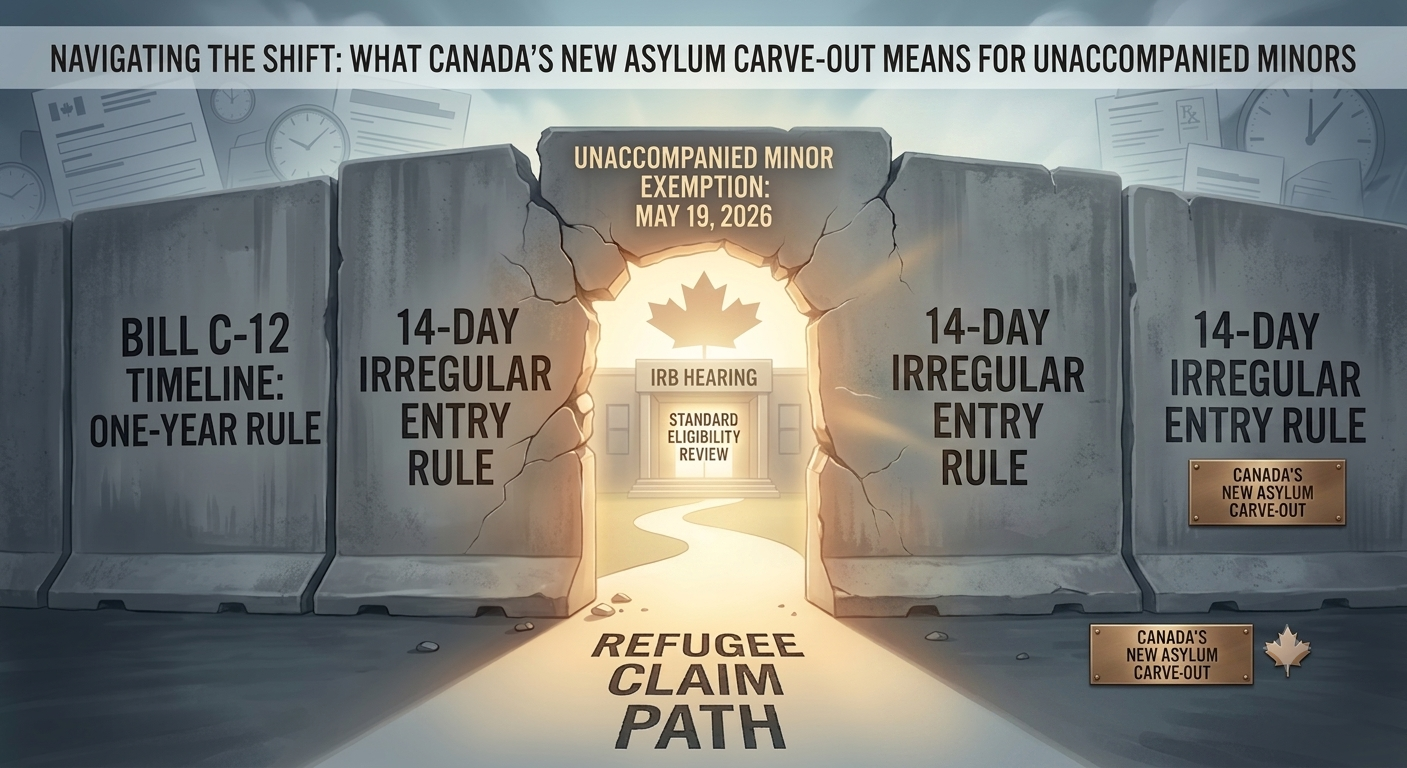
Navigating the Shift: What Canada’s New Asylum Carve-Out Means for Unaccompanied Minors
When Bill C-12 brought sweeping changes to Canada’s refugee system, it introduced strict timelines that caught many off guard. The “one-year rule” and the “14-day rule” for irregular entries essentially drew hard lines in the sand, rendering claims filed past those windows completely ineligible for referral to the Immigration and Refugee Board (IRB).
While these measures were designed to streamline a heavily burdened system, they inevitably created immense vulnerabilities especially for the most fragile group navigating our immigration landscape: unaccompanied minors.
Recognizing this, Immigration, Refugees and Citizenship Canada (IRCC) recently stepped in with a critical course correction. As of May 19, 2026, a new temporary public policy officially exempts unaccompanied minors from these rigid ineligibility timelines.
If you are a practitioner, an advocate, or a family supporter trying to understand what this means in practice, here is my breakdown of how this policy functions and who it actually protects.
The Core of the Issue: What Changed?
Under the strict framework of Bill C-12, asylum claims made on or after June 3, 2025, faced immediate rejection if they violated two key timelines:
The 1-Year Rule: Claims filed more than 365 days after a person entered Canada.
The 14-Day Rule: Claims filed 14 or more days after someone entered irregularly via the US-Canada land border.
Previously, even though unaccompanied minors had baseline protections under the Safe Third Country Agreement (STCA), they were still bound by Bill C-12’s clock once inside Canada. If a vulnerable youth missed that 14-day or one-year window due to confusion, lack of support, or trauma, their file was essentially locked out of the IRB.
The May 19 policy changes that. Delegated IRCC officers now have the authority to bypass both time restrictions for this group, allowing their claims to proceed to a standard eligibility review and, ultimately, a full hearing before the IRB.
Who Qualifies as an “Unaccompanied Minor”?
The policy is precise. To benefit from this specific exemption, a claimant must meet three strict criteria at the exact time their claim is filed:
Age: They must be under the age of 18. (Note: If they turn 18 later during the processing of their application, they are still protected, as long as they were a minor on the day the claim was submitted.)
Status: They must have a pending or active refugee claim in Canada.
Separation: They must have no parent or legally responsible adult currently with them in Canada.
Rule of Thumb: The critical factor is the date of the claim. Age and the absence of a legal guardian are assessed based on the day the paperwork is officially submitted.
What This Policy Doesn’t Do
As consultants, managing client expectations is half the battle. It is vital to understand that this is an exemption from timelines, not an exemption from the law itself.
No Blanket Approvals: This policy does not automatically grant refugee status. The minor’s claim must still undergo a rigorous eligibility review and meet all core requirements of the Immigration and Refugee Protection Act (IRPA).
No Retroactive Fixes: It does not reopen or reverse cases that were already ruled ineligible prior to May 19, 2026.
The Backup Option Remains: For anyone whose claim remains genuinely ineligible under other sections of the law, the Pre-Removal Risk Assessment (PRRA) is still the standard avenue to evaluate safety risks before any removal action is taken.
A Consultant’s Take: The Practical Approach
From an operational standpoint, there isn’t a separate, hidden application form to trigger this exemption. It requires meticulous front-end work during the initial application process.
If you are assisting a minor in this situation, the priority is identity and documentation. You must clearly declare the claimant’s unaccompanied minor status right at the outset of the eligibility review. Be fully prepared with robust evidence verifying both their age and the absolute lack of a legal guardian or parent present in Canada.
Final Thoughts
This temporary policy is a welcome acknowledgment by the government that children navigating a complex legal system alone cannot and should not be held to the same rigid administrative clocks as adults. It restores a layer of fairness and humanitarian flexibility to our system while a permanent legislative solution is worked out.
Navigating refugee and asylum frameworks in Canada requires a precise understanding of rapidly changing public policies. If you have questions about how these new timelines or exemptions impact a specific case, please reach out to our office directly to discuss your options.
Leave a Reply