

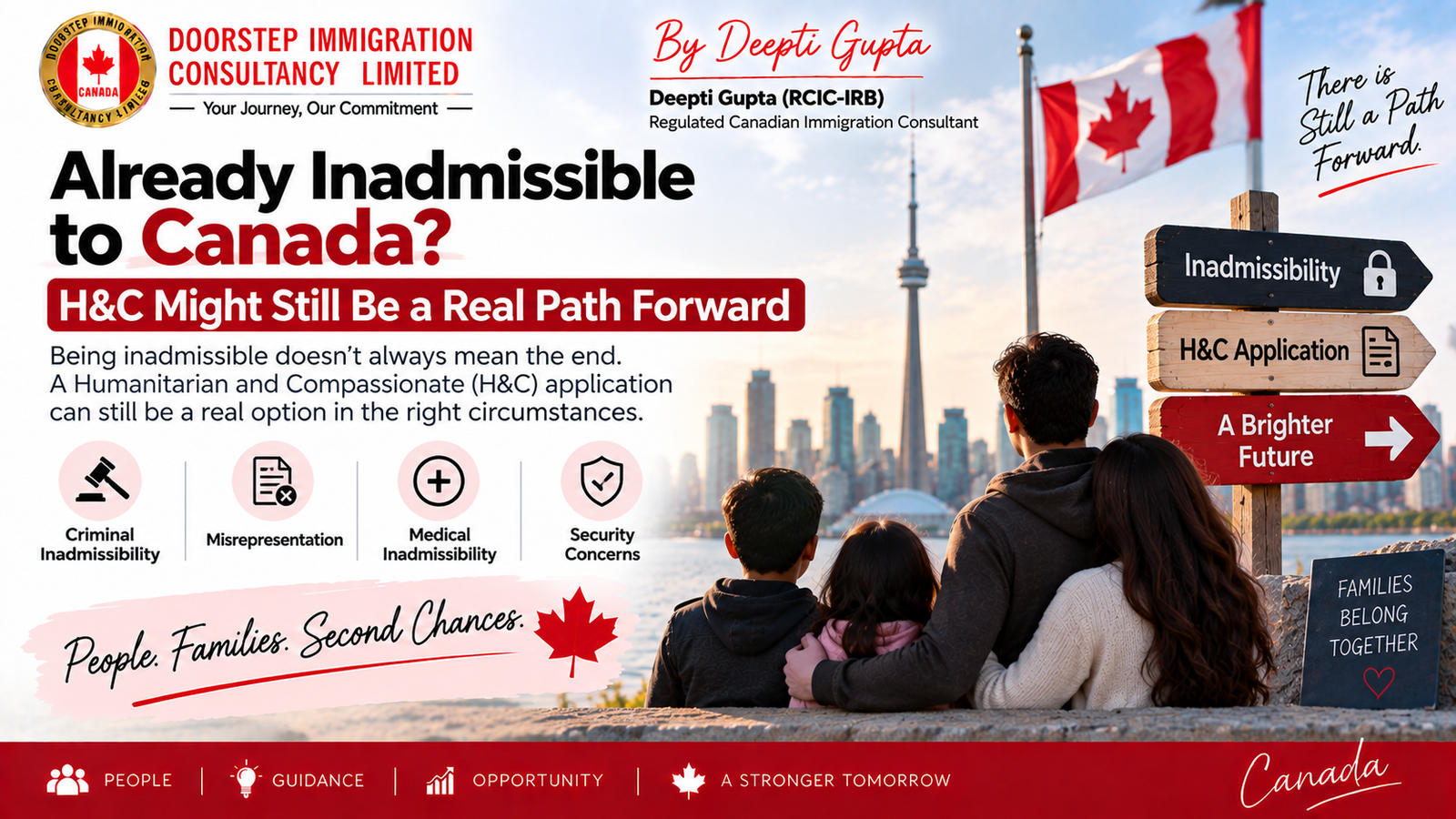
Already Inadmissible to Canada? H&C Might Still Be a Real Path Forward
One of the most common things I hear from people is some version of: “I know I’m inadmissible, so there’s nothing I can do.” That’s rarely true. It’s harder, slower, and requires a much stronger case but a Humanitarian and Compassionate (H&C) application can, in the right circumstances, work even when someone is already flagged as inadmissible.
This is one of the least understood corners of Canadian immigration law, mostly because the cases are so individual that there’s no simple checklist to point to. But there is a real path and I want to walk through how it actually works.
What inadmissibility means and why it doesn’t always close every door
Inadmissibility can come from several sources a past criminal conviction, a serious misrepresentation finding, a medical condition considered an excessive demand on health or social services or security or organized crime concerns. Each type carries different weight and H&C doesn’t erase any of them. What it can do in some circumstances is ask an officer to weigh the hardship of refusal against the humanitarian and compassionate factors in the person’s life and grant permanent residence despite the inadmissibility though certain categories, particularly serious security or criminality grounds face much steeper barriers than others.
A case that illustrates how this actually plays out
I worked with a client, Elena, who had been found inadmissible due to a misrepresentation finding from years earlier, tied to an incomplete disclosure on a previous application that she hadn’t fully understood the requirements of at the time. That finding came with a five-year bar and by the time she came to me she had already built a life in Canada during a period of authorized status a common-law partner who was a Canadian citizen, two Canadian-born children and a stable job she had held for years.
We built an H&C application that didn’t try to argue the misrepresentation away that ship had sailed but instead focused honestly on what would happen to her Canadian-citizen children if she were required to leave, the genuine hardship to her established family unit, her degree of establishment in Canada and the fact that the original misrepresentation, while real was not the kind of deliberate serious fraud the bar is primarily meant to address. The application was approved. It took patience and it took an honest, well-documented case not a case that pretended the inadmissibility wasn’t there.
What actually strengthens these applications
Best interests of any children involved. Officers are required to give this significant weight and it needs to be shown with real specifics school records, medical needs, community ties, not just asserted in general terms.
Genuine establishment in Canada. Length of time here matters, but so does depth steady employment, community involvement, informal support networks and whether the person has built a life that would be genuinely disrupted, not just inconvenienced.
Context around the inadmissibility itself. Not excusing it, but explaining honestly what happened, why, and what’s different now. Officers respond far better to a clear, factual account than to a case that avoids the issue entirely.
Hardship that is specific, not generic. “It would be hard to leave” isn’t enough. What specifically would be lost, a child’s ongoing medical treatment, a fragile family situation back home, a genuinely dangerous or unstable environment the person would return to.
What doesn’t work
Treating H&C like a loophole or filing it as a last-ditch, thin application after everything else has failed, tends to backfire. These cases require real time to build properly gathering documentation, structuring the narrative honestly and anticipating exactly how an officer will read the inadmissibility alongside the humanitarian factors. A weak H&C application doesn’t just fail it can also make a later, stronger application harder to bring since a refused H&C becomes part of the file’s history.
Why this file needs real strategy, not hope
H&C applications involving existing inadmissibility are some of the most demanding files in Canadian immigration law precisely because there’s no template every case depends entirely on the specific inadmissibility, the specific family situation and how honestly and thoroughly the story is told. If you or someone in your family is inadmissible and you’ve been told there’s nothing left to try, I had encouraged you to get a second opinion before accepting that. Reach out to me at Doorstep Immigration, and I’ll give you an honest read on whether an H&C case is realistically worth building for your situation.
Deepti Gupta
Surrey Office #236, 8138, 128 Street, Payal Business Centre, Surrey, BC, V3W 1R1, Canada
📧 dscanada18@gmail.com
📞 +1 778 228 3109 | +1 604 200 2999
Leave a Reply