

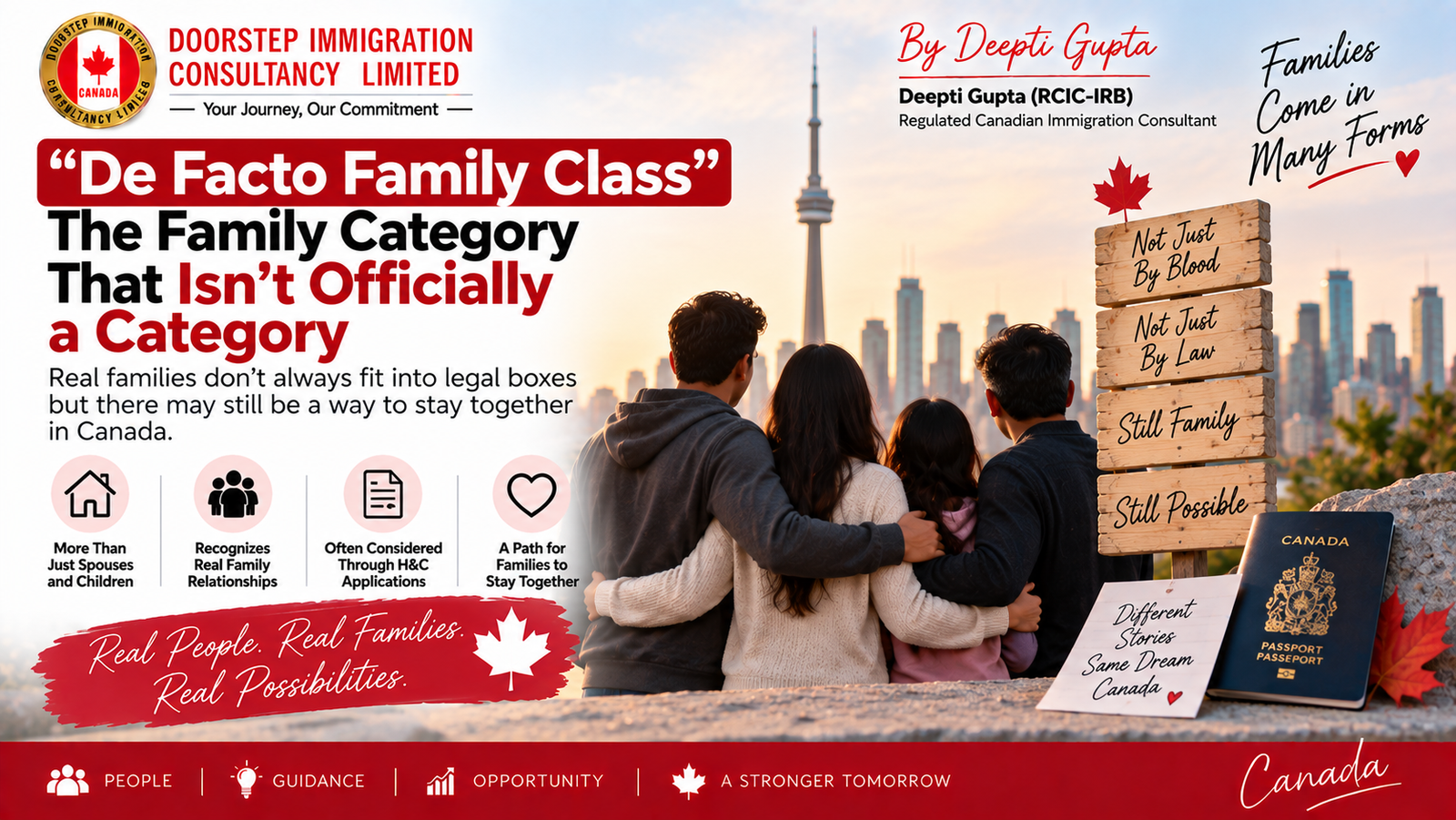
"De Facto Family Class": The Family Category That Isn't Officially a Category
If you searched IRCC’s website for a sponsorship stream called “De Facto Family Class,” you wouldn’t find an application form for it. There isn’t one. And yet, I’ve used this exact concept to help families stay together when nothing else in the regulations fits their situation. It’s one of the strangest corners of Canadian immigration law, a recognized idea with no dedicated application process of its own.
What it actually is
De facto family members are people who function as family in every real sense emotionally, financially, practically but don’t fit the legal definitions used in standard family sponsorship. Common examples I’ve seen:
An elderly relative who isn’t a parent or grandparent, an aunt, a family friend treated as a parent who has lived with and depended on the family for years
A child raised by a family without formal legal adoption ever being completed, often due to circumstances back home
A same-sex partner who couldn’t legally marry or register a common-law relationship in their home country and so can’t meet the technical definition of spouse or common-law partner
A sibling or cousin who was effectively raised as an immediate family member after the loss of their own parents
None of these people qualify under spousal, parent, grandparent, or dependent child sponsorship. There’s no box on the form for “the aunt who raised me as her own child” or “my partner, who I couldn’t legally marry where we’re from.”
Where this concept actually gets used
Because there’s no direct application stream, de facto family status gets raised in two main ways as a humanitarian and compassionate (H&C) factor within an application, or as a reason for an officer to exercise discretion when someone might otherwise be excluded from accompanying a family member’s application or from certain family reunification measures.
A case that shows how this plays out
I worked with a client, Fatima, who had lived with her uncle’s family since she was seven years old after her parents passed away. There was never a formal adoption in the region she came from that kind of arrangement is often handled informally within the extended family, without going through legal courts. By the time her uncle became a Canadian permanent resident and wanted to bring her over, she was 19 too old to qualify as his dependent child even if the family relationship had been legally formal and with no legal parent-child relationship on paper regardless.
We built the case around de facto family membership: years of financial dependency, school records listing her uncle as her guardian, a signed statement from community elders confirming the informal but recognized nature of the arrangement and a detailed account of the emotional and practical role he had played in raising her. This became the foundation of an H&C application, not a standard sponsorship, because that’s the only real avenue this kind of relationship has. It was approved but only because the file didn’t try to force her into the dependent child box, she didn’t technically fit. It argued honestly for what she actually was: a de facto daughter.
Why this category trips people up
People assume it’s a sponsorship stream you can just apply for. It isn’t. There’s no dedicated form, no dedicated processing stream. It only becomes relevant inside a broader H&C argument or a discretionary decision.
The evidence bar is high and it’s not the usual paperwork. Standard sponsorship relies on marriage certificates and birth certificates. De facto cases rely on lived proof, years of school records, financial support, community statements, photographs across time, anything showing the relationship existed and mattered long before the application was ever filed.
It’s easy to undersell how strong these cases can be. Because there’s no official category, people sometimes assume these situations are hopeless. In my experience, a well-documented de facto family relationship can be one of the more compelling H&C stories precisely because the depth of the relationship is so evident once it’s properly laid out.
Why this needs a very specific kind of case-building
There’s no template for a de facto family case, because there’s no form built for it every single one has to be constructed from scratch, built entirely on the strength of the evidence and the narrative around it. This is exactly the kind of file that gets refused when it’s rushed and approved when it’s built patiently and honestly.
If your family includes someone who has always felt like immediate family but doesn’t fit the legal boxes a relative who raised you, a partner you couldn’t legally marry, a child you’ve cared for without formal adoption don’t assume there’s nothing that can be done. Reach out to me at Doorstep Immigration, and let’s talk about whether a de facto family argument could work for your situation.
Doorstep Immigration
– Surrey Office #236, 8138, 128 Street, Payal Business Centre, Surrey, BC, V3W 1R1, Canada
📧 dscanada18@gmail.com
📞 +1 778 228 3109 | +1 604 200 2999
Leave a Reply