

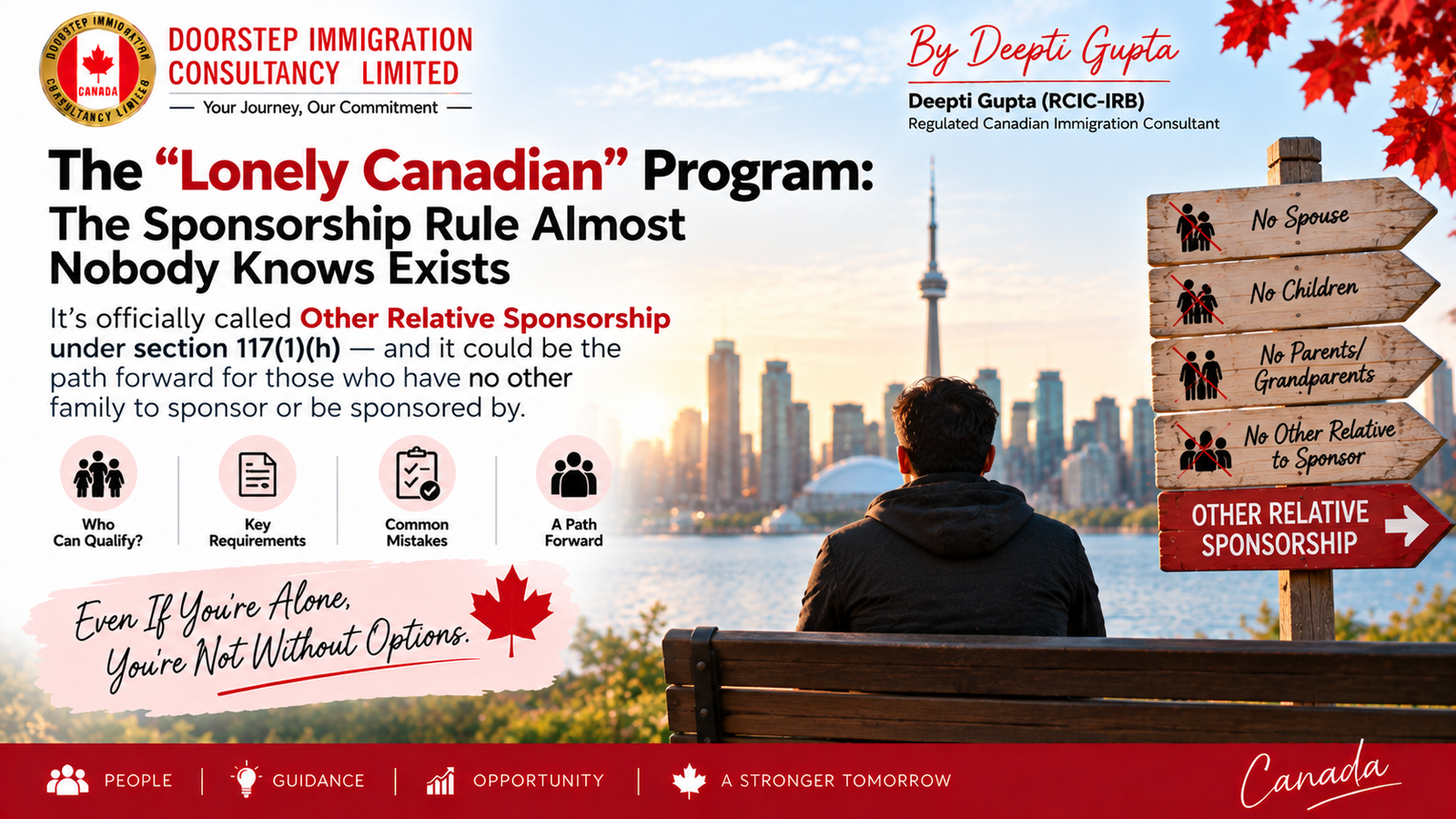
The "Lonely Canadian" Program: The Sponsorship Rule Almost Nobody Knows Exists
If you’ve spent any time researching how to bring family to Canada, you’ve read about spousal sponsorship, parent and grandparent sponsorship, and dependent children. What you probably haven’t read about is the rule that exists for the person who has none of those relatives to sponsor and no one to sponsor them either.
It’s informally called the “Lonely Canadian” program. IRCC doesn’t use that name officially the real term is Other Relative Sponsorship, found under section 117(1)(h) of the Immigration and Refugee Protection Regulations. But the nickname stuck for a reason: this rule was built for people who are, in the truest sense alone in Canada.
Who this is actually for
Picture a client I’ll call Aarav. He came to Canada on a work permit over a decade ago, became a permanent resident then a citizen. His parents passed away years before he immigrated. He has never married, has no children and his only living relatives, a sister and a nephew are still overseas. Under standard family sponsorship categories, Aarav has no one he can bring over. No spouse to sponsor. No kids. No living parents or grandparents.
This is exactly the gap Other Relative sponsorship closes. If you are a Canadian citizen or permanent resident with:
No spouse, common-law partner, or conjugal partner
No dependent children
No living parents or grandparents who are Canadian citizens or permanent residents
No other relative, anywhere in the world, who you could sponsor instead
…then you may be permitted to sponsor one relative of any age, related by blood or adoption, a sibling, aunt, uncle, niece, nephew, or adult child who wouldn’t otherwise qualify as a dependent.
Where people trip up
This is where I see most applications go wrong and it’s rarely the paperwork, it’s the eligibility test itself.
The “anywhere in the world” trap. I had a client convinced she qualified because she had no family in Canada. But the rule doesn’t ask whether you have family in Canada, it asks whether you have any sponsorable relative anywhere, including a cousin’s child abroad you’d never have thought to sponsor. If a foreign national relative exists who you could sponsor under a different category, IRCC expects you to use that category instead, even if you have no relationship with that person.
Assuming a deceased relative doesn’t count against you. It doesn’t, a parent who has passed away isn’t counted as disqualifying you. But a parent who is alive and simply estranged still counts. Distance and disconnection aren’t the same as absence in the eyes of the regulation.
Choosing the wrong relative to sponsor. You get one shot at one relative under this category. I’ve seen applicants pick based on emotional closeness rather than who has the strongest, most well-documented case and then struggle to prove the blood or adoptive relationship years later when records are incomplete.
What the process actually demands
Because this category is rare, officers scrutinize it more closely than a routine spousal file. You’ll need to prove a negative that no qualifying relative exists which means:
A full family tree with supporting documents (birth, marriage, and death certificates)
Clear proof of your relationship to the relative you’re sponsoring
Proof of your financial capacity, since you’re signing an undertaking to support that relative typically for 10 years, sometimes longer depending on their age
In Quebec, a separate undertaking process through MIFI, which currently has its own caps on other-relative sponsorships timing matters if you live there
Processing tends to run longer and less predictably than standard sponsorships, precisely because so few officers see these files regularly.
Why this file needs an experienced hand, not a template
This isn’t a category where a generic checklist gets you through. Every “Lonely Canadian” case is a negative-proof case you’re not just showing IRCC who your relative is, you’re proving an absence of alternatives across your entire extended family, sometimes across three countries and two generations. One overlooked distant relative, one undocumented family death, one wrong assumption about who “counts,” and the file comes back refused or stalled in procedural fairness requests.
This is exactly the kind of file we specialize in the ones other offices turn away because they’re unfamiliar, slow, or “too complicated to bother with.” If you think you might qualify as a Lonely Canadian sponsor, or you’re not sure whether a distant relative disqualifies you, get in touch with Doorstep Immigration before you file. We’ll map your full family situation, tell you honestly whether you qualify, and if you do, build the file the way IRCC actually wants to see it the first time.
Leave a Reply